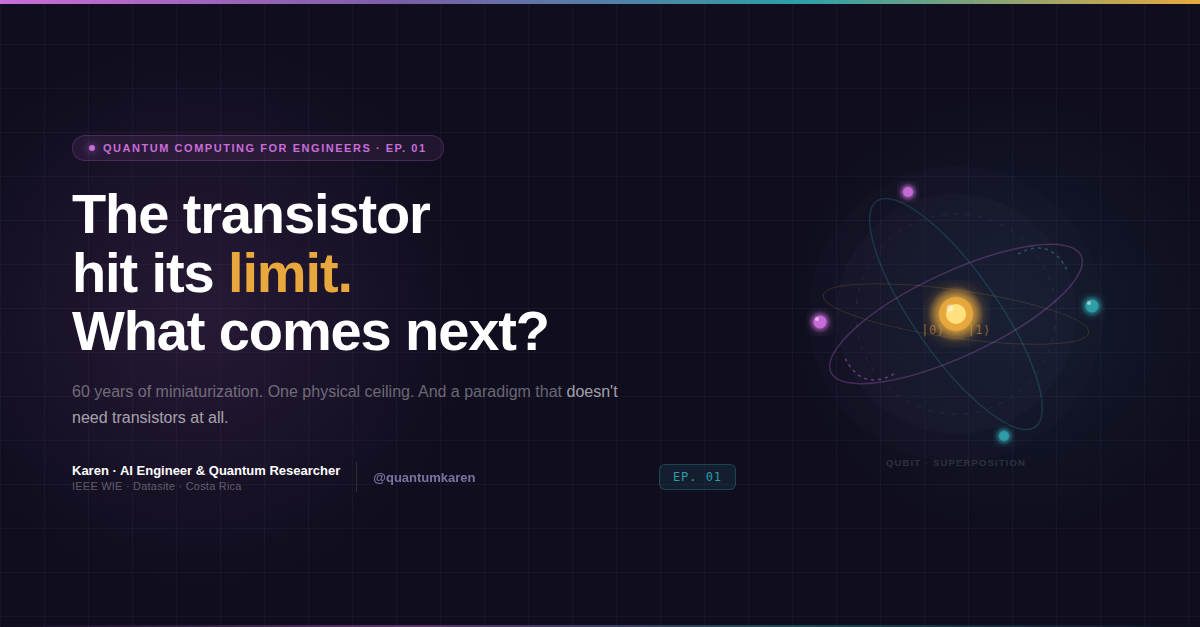
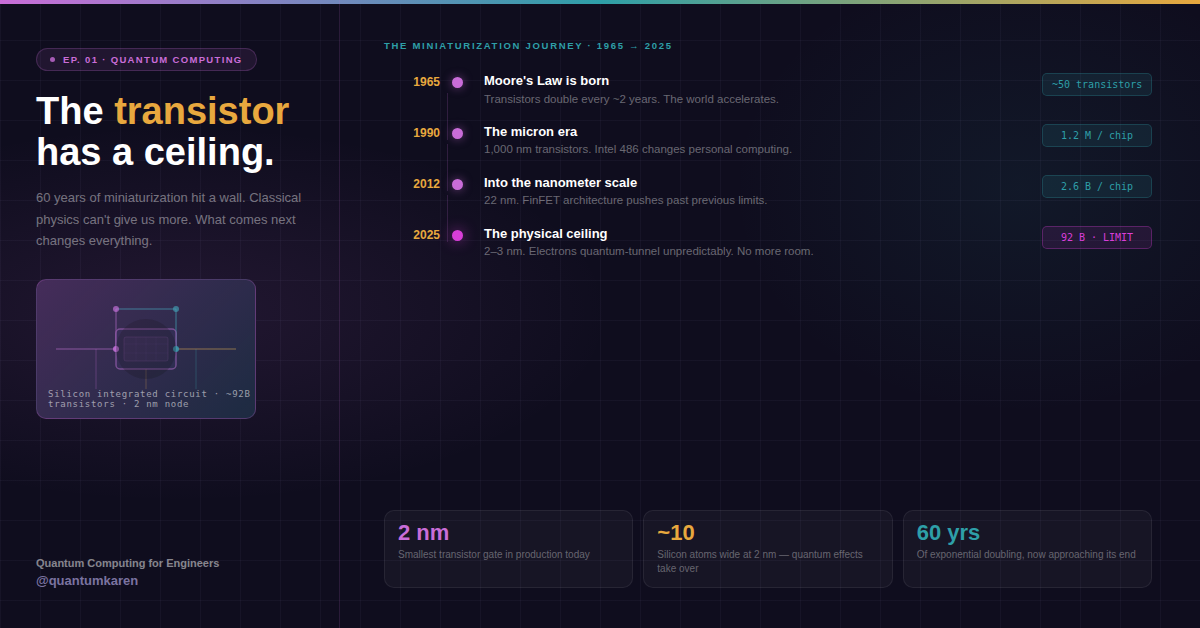
In 1965, Gordon Moore, co-founder of Intel, observed that the number of transistors on an integrated circuit doubled roughly every two years. That prediction held with remarkable consistency for six decades. This figure has grown approximately 100 million times since the Intel 4004's 2,300 transistors in 1971, a rate of progress unmatched in any other engineering discipline.
The Physics Problem No One Talks About
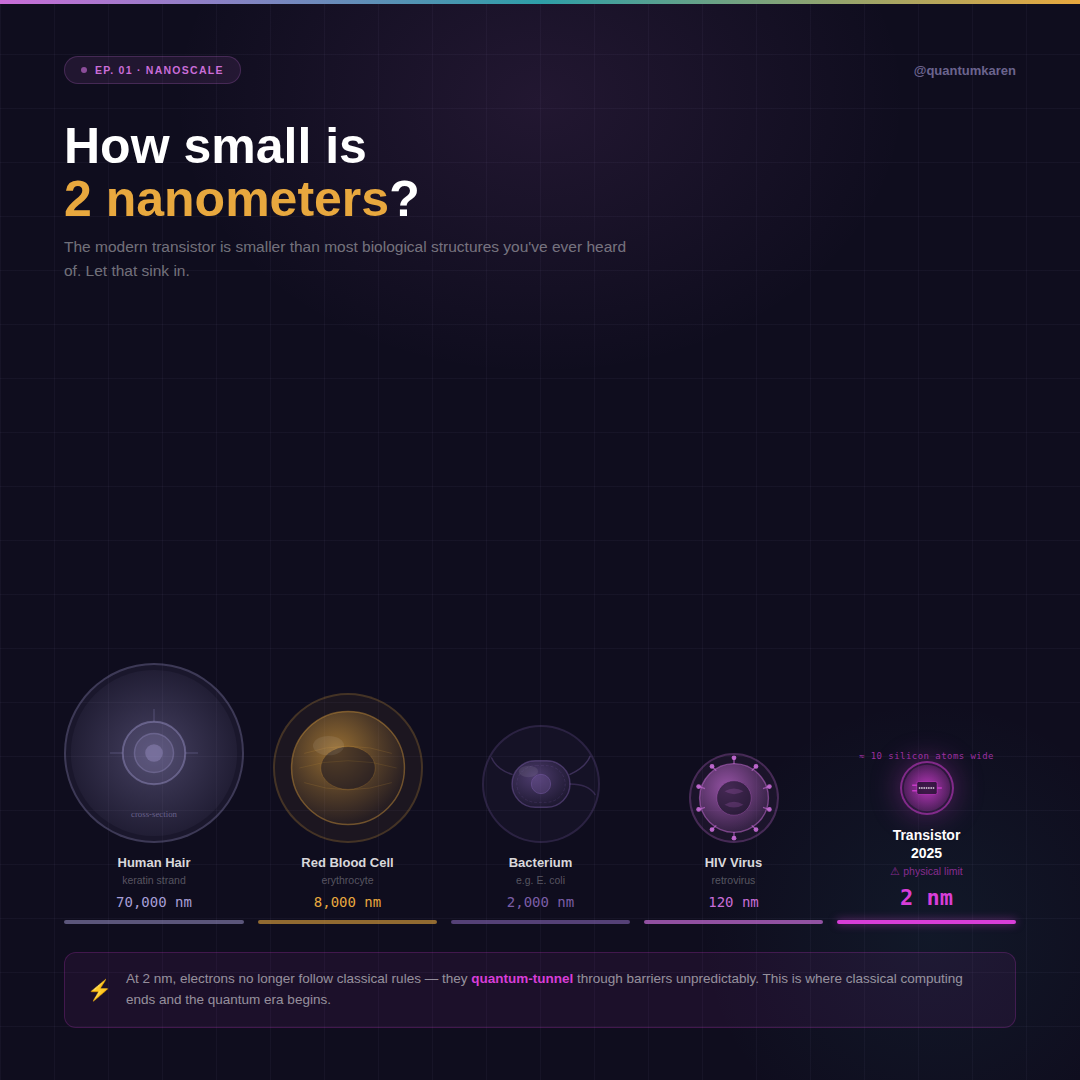
The image above illustrates just how far miniaturization has taken us. The transistor, that switch that powers every calculation our devices make, is now smaller than a virus and smaller than a red blood cell. In 2022, IBM unveiled the world's first chip built on a 2 nm process node, a scale so extreme it forces us to confront a problem that has nothing to do with engineering ambition.
The MOSFET, the building block of most integrated circuits, has shrunk a thousandfold over the past half century, from the tens-of-micrometers scale in the 1960s to tens of nanometers today. But at these dimensions, the rules change. As devices shrink below 10 nm, quantum effects including tunneling transition from background noise to the dominant factor limiting further scaling.
This is not an engineering problem we can optimize in the way we used to. At such a tiny scale, resistive channels start leaking owing to quantum tunnelling, affecting transistor performance, and ultimately limiting operating frequency due to increased static power dissipation. Published in Nature Nanotechnology in 2024, this finding confirms what semiconductor engineers have known for years: the physics itself is drawing the line.
"As the source-to-drain distance of a transistor approaches the nanometer scale, quantum-tunneling-mediated transmission through the potential energy barrier increases exponentially, leading to high leakage current. The electrons, simply put, stop obeying."
Moore's Law Is Not Dead, But It Is Transformed
To be fair, the semiconductor industry isn't giving up. Engineers have found clever ways to keep pushing, redesigning the shape of transistors themselves to squeeze out more performance. But here's the honest truth: each new generation of chips costs more, takes longer, and delivers less improvement than the one before. The easy gains are gone.
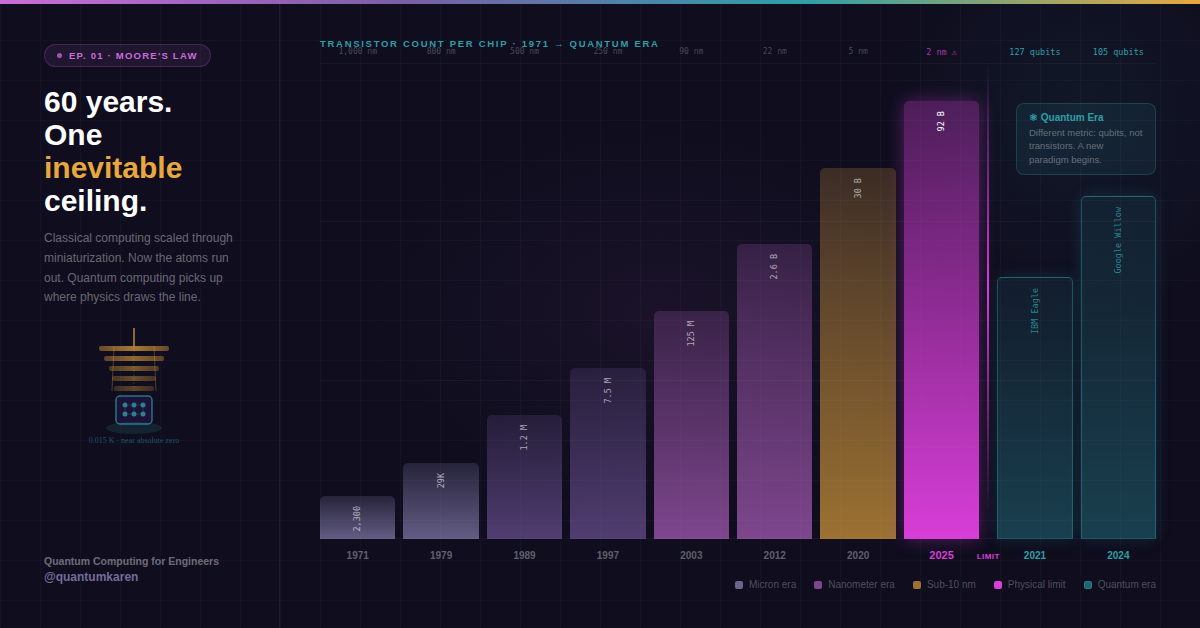
At the heart of the problem lies quantum mechanics. The progress that gave us gadgets and capabilities previous generations could scarcely imagine is now under fundamental physical threat.
The ceiling is real. The question is what we build beyond it.
Enter Quantum Computing
Quantum computing does not try to shrink the transistor further. It abandons the paradigm entirely. It tries to discover what else we can use.
Rather than encoding information as classical bits — zeros and ones controlled by transistor switches — quantum computers use qubits that exploit the same quantum mechanical phenomena that make further miniaturization so difficult. Superposition, tunneling, entanglement: the enemy of the classical transistor becomes the foundation of a new architecture.
MIT researchers have fabricated tunneling transistors that leverage quantum tunneling to encourage electrons to push through energy barriers rather than going over them, an early signal that quantum effects, properly harnessed, open new computational doors rather than closing old ones.
The progress is accelerating. Google's Willow chip, with 105 superconducting qubits, demonstrated exponential error reduction as qubit counts increased — a milestone the field calls going "below threshold." IBM's roadmap projects verified quantum advantage confirmed by the broader scientific community before the end of 2026.
Traditional transistors based on CMOS are facing significant limitations as device scaling reaches the limits of Moore's Law, including increased leakage currents, pronounced short-channel effects, and quantum tunneling through the gate oxide. Tunnel Field-Effect Transistors and quantum architectures are emerging as the responses the industry is betting on.
Why This Matters Now, Not in 20 Years
There is a narrative in tech media that quantum computing is perpetually "a decade away." That narrative is becoming harder to sustain. The global quantum computing market is projected to reach $20 billion by 2030, and national governments invested over $10 billion in the sector in 2024-2025 alone.
The industry has shifted from asking if quantum computing will be practically useful, to asking which applications will benefit first and when.
What I Think About This
I work at the intersection of AI and quantum computing, and I will be honest: AI is getting all the attention right now, and for good reason. But the physical ceiling of classical computing is real, and the architectures running our most powerful AI systems are approaching their limits.
Quantum computing is not a replacement for classical computing of course. It is just a different tool, designed for a different class of problems like drug discovery, materials science, cryptography, optimization at scale, and yes, quantum machine learning.
"The transistor gave us 60 years of exponential progress. What comes next will not look like a smaller transistor. It will look like a qubit."
I'm building a series explaining quantum computing from the ground up, no physics PhD required. Follow along if you want to understand Quantum Computing in an easy and fun way.
- Unikeyic — How Many Transistors Are In A CPU?
- Veerasingam, M. — Quantum Tunneling and the Semiconductors' Struggle in the Miniaturization Race
- IEEE Spectrum — The Tunneling Transistor
- Nature Nanotechnology — Quantum interference enhances the performance of single-molecule transistors (2024)
- Phys.org — Quantum interference could lead to smaller, faster, and more energy-efficient transistors
- Microchip USA — The Future of Semiconductor Miniaturization
- Nature Electronics — Scaled vertical-nanowire heterojunction tunnelling transistors (2024)