The entry point is not the problem
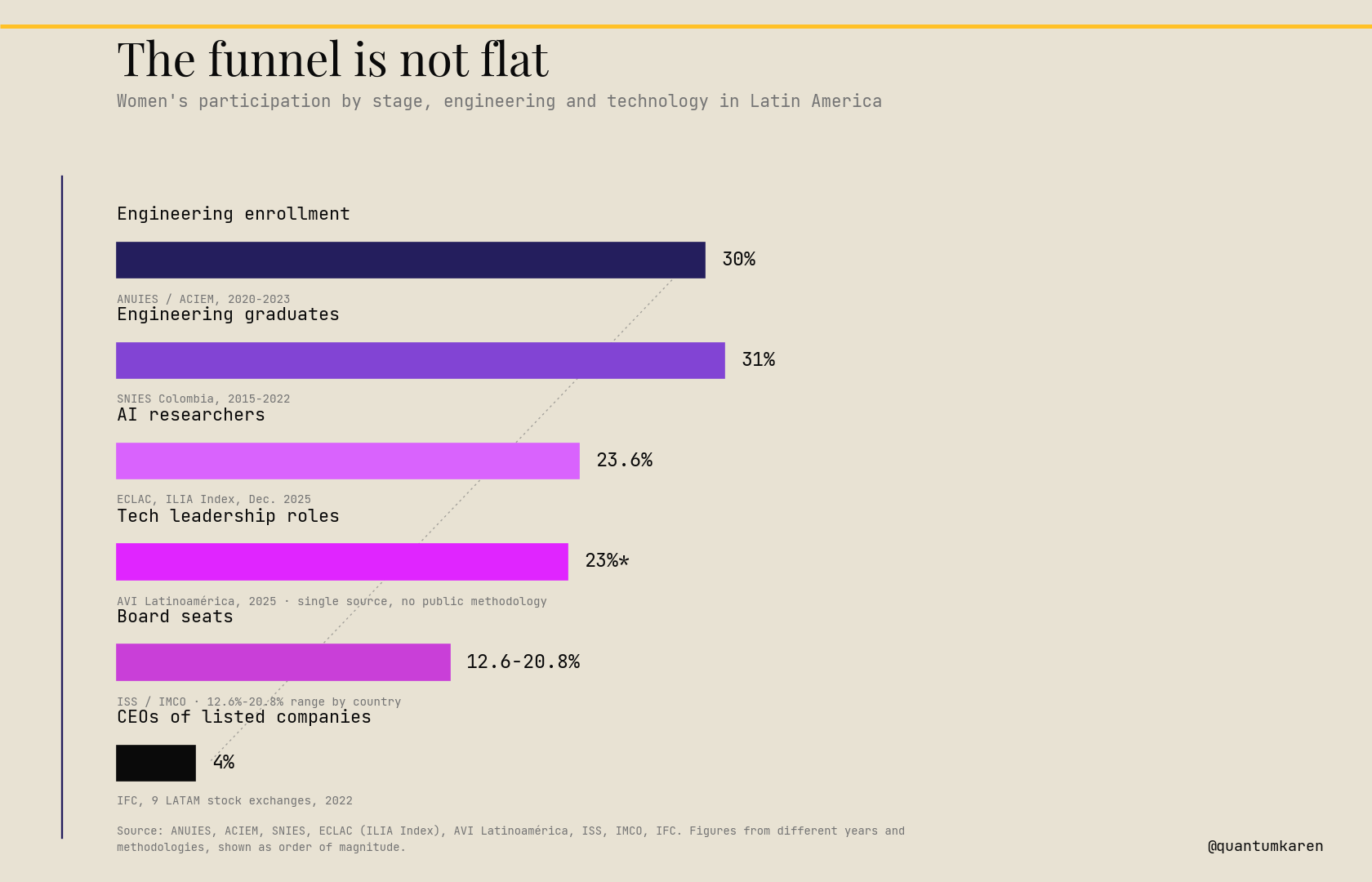
In Mexico, during the 2020–2021 cycle, 31% of engineering enrollment was women, up from 27% a decade earlier. In Colombia, between 2015 and 2022, women made up an average of 30.7% of enrollment and 32.9% of graduates — a slightly higher share than enrollment, because women drop out less than men do.
In other words: at the entry point, the gap is already 70–30, but it's stable, and it isn't getting worse. The problem isn't there.
Where the real collapse starts
The gap stays roughly similar in research. According to a report by UN Women and UNESCO's Regional Science Office, in 2017 women made up 36% of engineering and technology researchers in Uruguay, 26% in Colombia, 24% in Costa Rica, 21.5% in Honduras, and around 19% in Bolivia and Peru.
The pattern breaks in leadership. A specialized trade outlet (AVI Latinoamérica) reports that 23% of leadership positions at tech companies in the region are held by women, without publishing the methodology behind that figure, so I treat it as an approximation, not a hard data point. Only 21% of people founding digital startups in Latin America and the Caribbean are women, according to UN Women. On the boards of publicly listed companies, female participation varies considerably by country — from 12.6% in Mexico to 20.8% in Colombia, the best-performing country in the region. And among those who reach CEO of a listed company, the figure drops to 4%, according to an IFC study covering nine Latin American stock exchanges.
The pattern is consistent: the closer a role sits to a decision over budget, hiring, or strategy, the lower women's participation. This isn't a gradual leak. It's a bottleneck located precisely where decision-making power concentrates.
There's one more data point worth not skipping past. McKinsey documented that between 2022 and 2024, exactly when the region's e-commerce sector grew 25% and pulled in a wave of new female talent into tech roles, the leadership gap started widening for the first time since 2016. Sector growth didn't fix representation. It made it worse.
The case of artificial intelligence
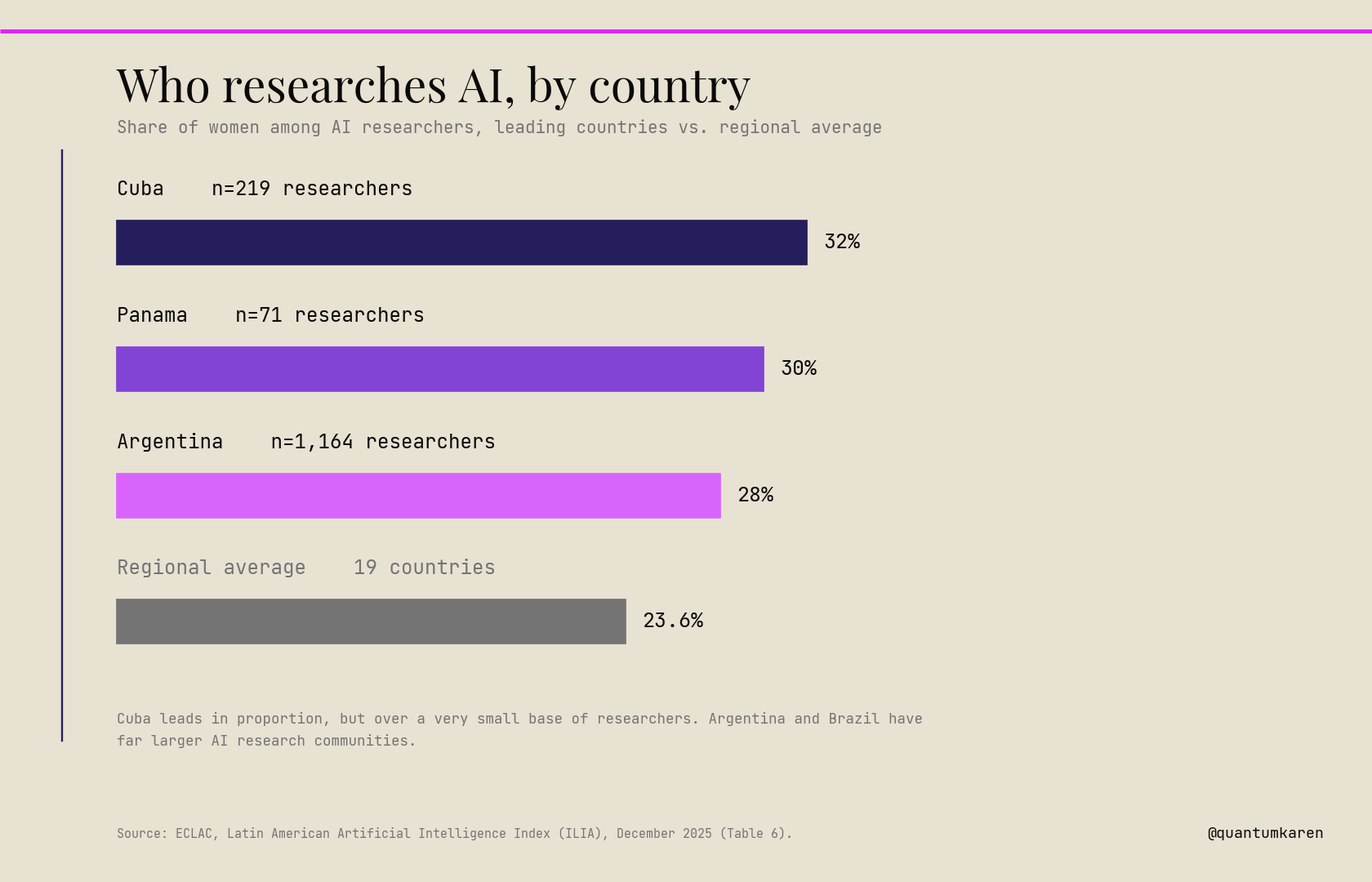
AI, my other field, is no exception. According to the Latin American Artificial Intelligence Index (ILIA) published by ECLAC in December 2025, only 23.6% of those researching AI in the region are women, up from 19.8% in the prior edition. Cuba, at 32%, and Panama, at 30%, lead. Argentina follows at 28%.
A necessary caveat, because Cuba's figure is easy to misread if used on its own: Cuba has a total of 219 active AI researchers reported in the index, of which 72 are women. Panama has 71 researchers total. Argentina, by contrast, has 1,164, and Brazil has 11,500. Cuba's 32% is a real number, but it comes from a much smaller base than Argentina's 28%, so they aren't equally robust figures even though they sit in the same table.
This isn't a technical footnote. When the teams designing and evaluating AI systems lack gender diversity, biases in training data get built into the model without anyone questioning them along the way. That's not an abstract hypothesis — there are already hiring-screening systems in production reproducing historical hiring patterns.
What actually moves the 4%
"Inspire girls to code" programs act on enrollment, which is no longer where the problem is. What moves the 4% are different levers: audited and published promotion criteria, board quotas with a real deadline, and salary transparency by pay band rather than by overall average — because the average hides exactly the gap that matters.
The pay gap, measured by band, confirms this. In industrial engineering in Mexico, the average overall salary is 23,572 pesos a month; for women, it's 19,942. In software development, the gap narrows to 24,758 versus 23,712. Function matters almost as much as title.
The funnel doesn't get fixed by inspiring more girls to enter. It gets fixed by redesigning what happens once they're already inside.
- ANUIES — National Association of Universities and Higher Education Institutions, Mexico
- Colombian Association of Engineers (ACIEM)
- National Higher Education Information System (SNIES), Colombia
- UN Women and UNESCO Regional Science Office for Latin America and the Caribbean (2017)
- Soto, Á. et al., Latin American Artificial Intelligence Index (ILIA) 2025, ECLAC and CENIA, December 2025 (Table 6, Share of women AI authors)
- AVI Latinoamérica (2025, single-source figure, no public methodology)
- UN Women, Women's Participation and Leadership in the Digital Transformation (2026)
- ISS, Gender Diversity in Latin American Boards (2024)
- IMCO, Women in Business (2025)
- International Finance Corporation (IFC, 2022)
- McKinsey, Unfinished Business: The Ongoing Tech Gender Gap in Latin America (2025)
Methodological note: figures in this piece come from sources with different years, methodologies, and sample sizes. They are presented as an order of magnitude to show a regional pattern, not as a strictly comparable point-by-point series.