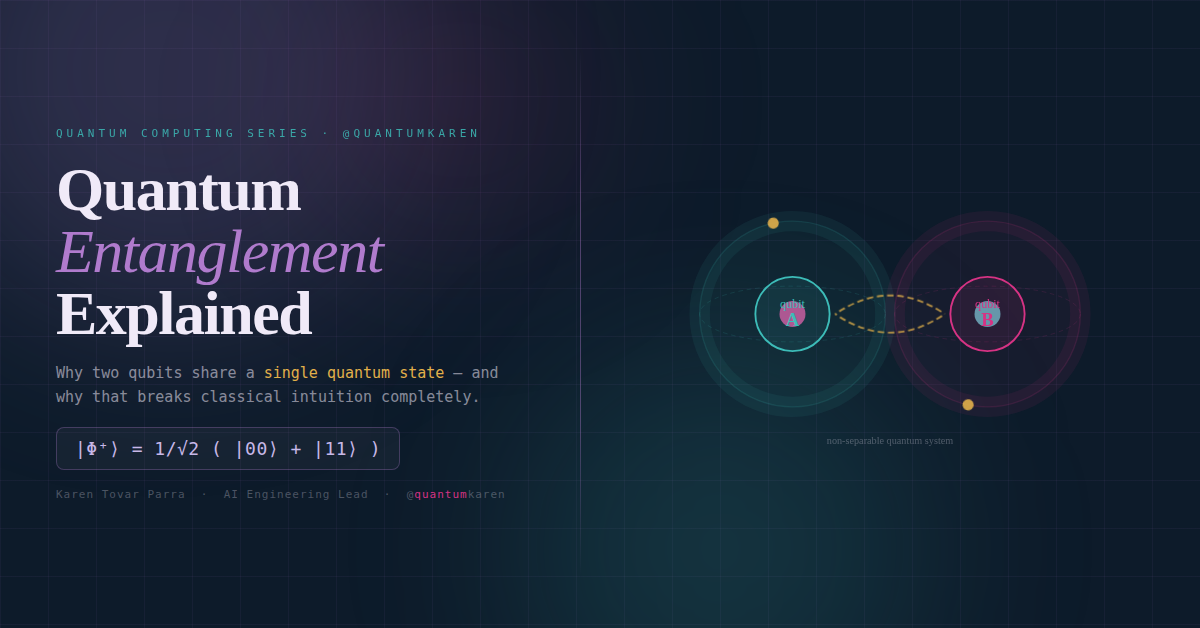
One Story, Two Qubits: Quantum Entanglement Explained

One Story, Two Qubits: Quantum Entanglement Explained Una Historia, Dos Qubits: El Entrelazamiento Cuantico Explicado

Back to BlogVolver al Blog

Most explanations of quantum entanglement reduce one of the most mathematically precise concepts in physics to a vague metaphor. Here is what is really happening.

Most explanations of quantum entanglement are very simplified and they can be under the wrong concepts.

They reduce one of the most mathematically precise concepts in physics to a vague metaphor of particles "communicating" across space. That framing is not just imprecise. It actively obscures what makes entanglement powerful, and why it matters for the future of computing.

Here is what is really happening.

What Entanglement Really Is

Entanglement is not a correlation between two particles. It is the structural impossibility of describing two qubits as two independent systems at all.

To understand why, start with the separable case. When two qubits are not entangled, their joint state factorizes cleanly:
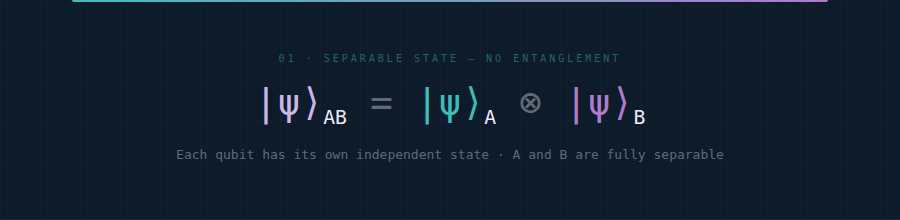
Separable state equation

Each qubit has its own well-defined state. You can describe qubit A fully, precisely, without any reference to qubit B. They are independent systems that happen to coexist. Think of two separate books. You can read one without opening the other.

The Bell State: One Story, Two Qubits

Now meet the Bell state. Named after physicist John Bell, it is the simplest and most important example of a maximally entangled two-qubit state:
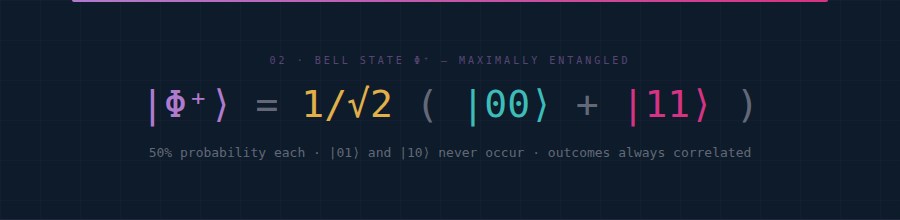
Bell state equation

For non-physicists, here is what that notation says in plain language.

The system can be in two possible outcomes: both qubits are 0, or both qubits are 1. The 1/sqrt(2) coefficient means each outcome has exactly 50% probability. So far it sounds like a coin flip. But here is where it gets strange.

In a normal coin flip, the coin is secretly heads or tails the whole time. We just do not know which. In the Bell state, neither qubit has a definite value before measurement. The outcome does not exist yet. Both possibilities are real and coexisting simultaneously. When you measure, the system resolves into one of them instantly, for both qubits at the same time, regardless of how far apart they are.

Notice also what is missing from that equation. There is no |01⟩ and no |10⟩. The system will never resolve into A=0, B=1 or A=1, B=0. The two qubits are perfectly correlated in a way that cannot be explained by any pre-existing agreement between them. John Bell proved this mathematically in 1964, and experiments have confirmed it ever since.

Mathematically, the reason this state is so special is that it cannot be separated. Try to factorize it. Assume there exist α, β, γ, δ such that the tensor product holds:

|Φ⁺⟩ = (α|0⟩ + β|1⟩) ⊗ (γ|0⟩ + δ|1⟩)

Expand and compare coefficients term by term. You get:
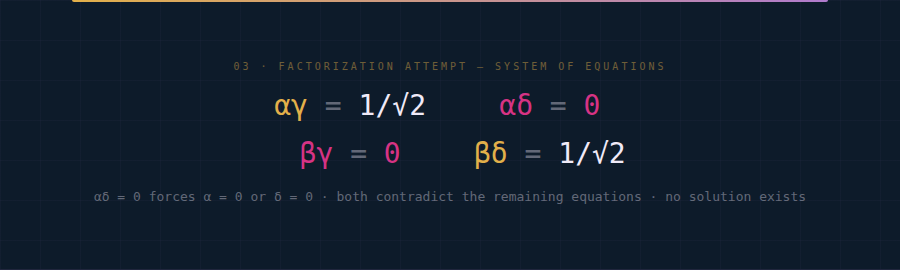
Factorization system of equations showing no solution exists

From αδ = 0, either α = 0 or δ = 0. If α = 0, then αγ = 0, contradicting αγ = 1/√2. If δ = 0, then βδ = 0, contradicting βδ = 1/√2. Both paths lead to contradiction. No solution exists.

This is not a physical claim. It is a mathematical fact about the structure of the joint Hilbert space Hₐ ⊗ Hᵇ.

Going back to the book analogy: this is not two books that happen to tell the same story. This is one story that cannot exist in two separate books at all. The moment you open either one, the full story resolves, for both, simultaneously.
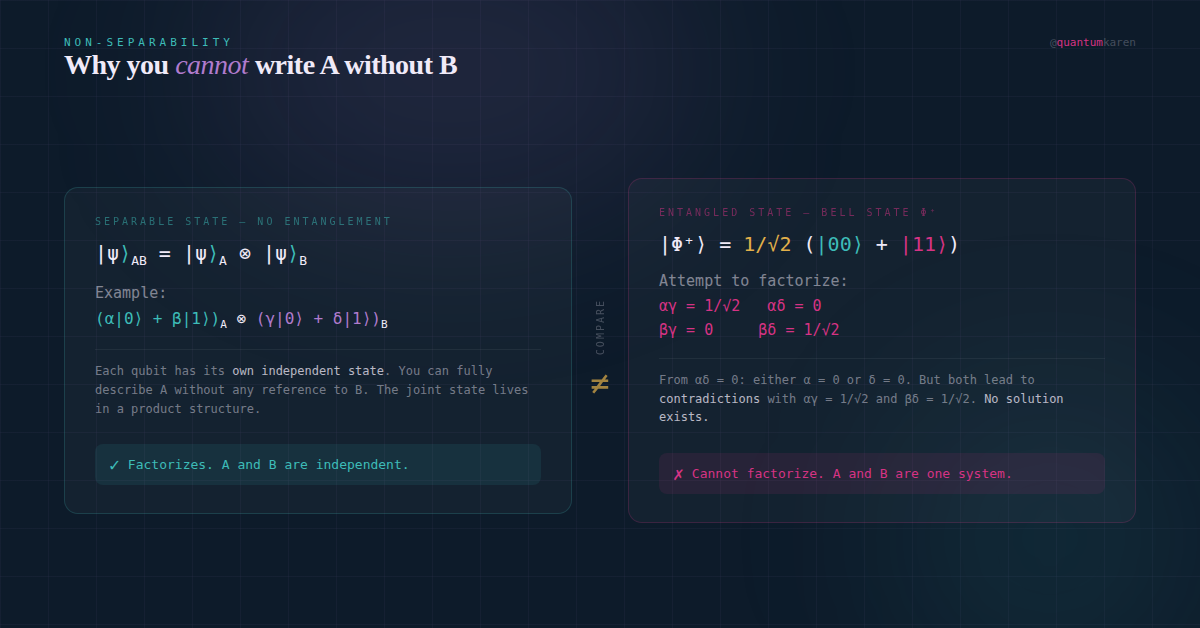
The Bell state represents one story that cannot be separated into two independent books

The No-Communication Theorem

If measuring A instantly determines B, does that mean information traveled faster than light?

No. And the proof is elegant.

If you only have access to qubit B, your local state is the reduced density matrix, obtained by tracing out A:
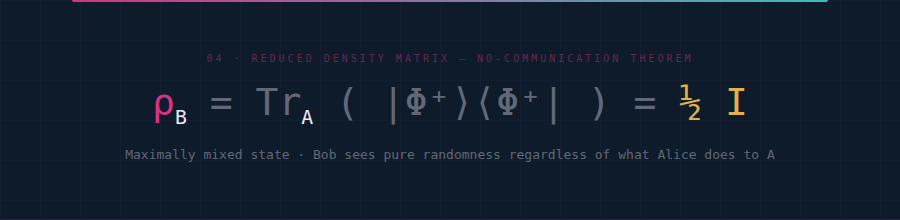
Reduced density matrix showing maximally mixed state

The result is the maximally mixed state. Pure randomness. No matter what Alice does to qubit A, whether she measures it, applies any operation, or leaves it untouched, Bob's local statistics are completely unchanged.

In plain terms: Bob sees 0 and 1 with equal probability no matter what. He has no way of knowing whether Alice measured her qubit or not. The correlation only appears when both compare results through a regular, classical communication channel.

What travels instantly is the correlation. Not the information.

This is the no-communication theorem, and it is exact.
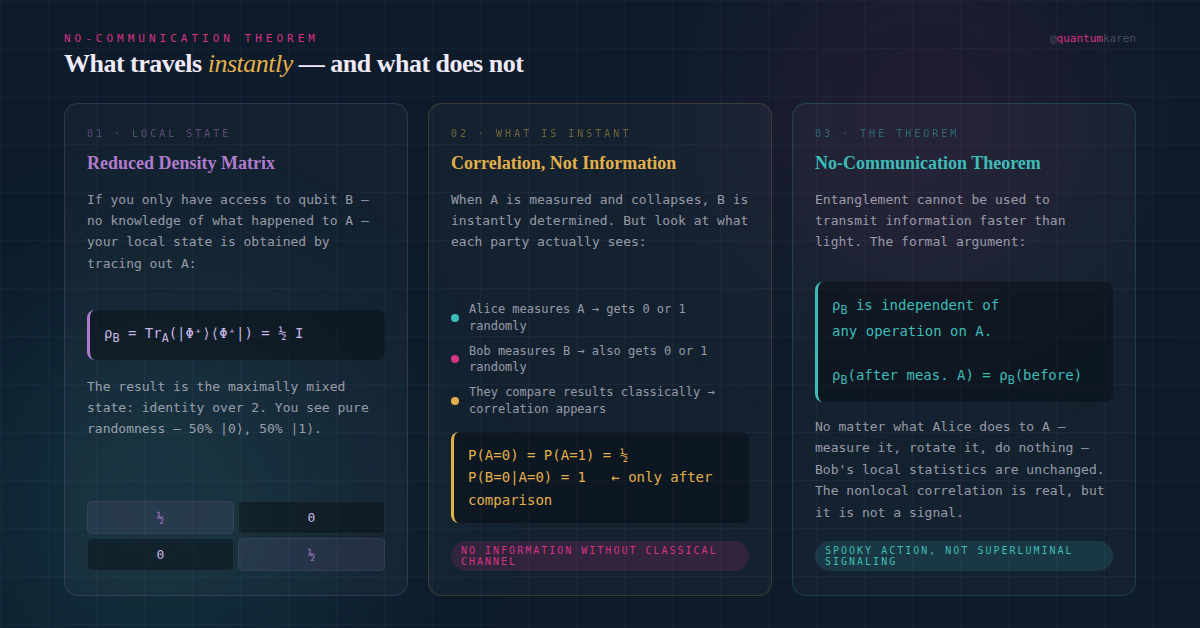
The no-communication theorem: correlation travels instantly, but information does not

Why This Connects to the Future of Computing

I wrote recently about how classical computing is approaching a physical ceiling. Transistors have shrunk below 10 nm, where quantum tunneling starts working against us rather than for us. Moore's Law is not dead, but it is running out of room.

Quantum computing does not try to push transistors further. It abandons the paradigm entirely and builds on the same quantum mechanical phenomena that make miniaturization so difficult, turning them into a computational resource.

Entanglement is that resource. It is not a curiosity. It is what makes certain quantum computations structurally impossible to replicate on classical hardware:

  • Quantum teleportation: an unknown quantum state is reconstructed at a distant location using entanglement plus exactly 2 classical bits. No quantum channel required during transmission. Demonstrated theoretically in 1993 and experimentally verified multiple times since.
  • Quantum key distribution: cryptographic security guaranteed by physics, not computational hardness. Any eavesdropping attempt introduces detectable disturbances to the quantum state. The BB84 protocol, proposed in 1984, remains the foundation of this field.
  • Quantum error correction: entangled ancilla qubits allow a system to detect and correct errors without ever directly measuring the data being computed. This is the mechanism behind Google's Willow chip achieving exponential error reduction as qubit counts scale up.
  • Quantum advantage: entangled states allow algorithms to explore exponentially large Hilbert spaces in ways no classical system can replicate. This is not a matter of speed. It is a matter of structure.

The power of entanglement is not that it defies relativity.

The power is that it defies classical intuition about what a system even is.

Why the Misconceptions Persist

Einstein himself called entanglement "spooky action at a distance" and spent years arguing it proved quantum mechanics was incomplete. The EPR paradox he co-authored in 1935 was one of the most serious attempts to show that the theory needed hidden variables to be coherent.

Bell's theorem in 1964 closed that argument mathematically. Decades of experiments confirmed it. Entanglement is not a sign that the theory is broken. It is a sign that reality is genuinely stranger than our classical intuitions allow.

Entanglement does not give us magic. It gives us a new mathematical structure for storing and processing information, one that has no classical equivalent.

That is what we are learning to engineer.

How Do You Actually Create Entanglement?

The natural question is: if entanglement is so powerful, how do we produce it? The answer is surprisingly simple. A Hadamard gate puts qubit A into superposition. A CNOT gate then correlates qubit B with A. The result is the Bell state:
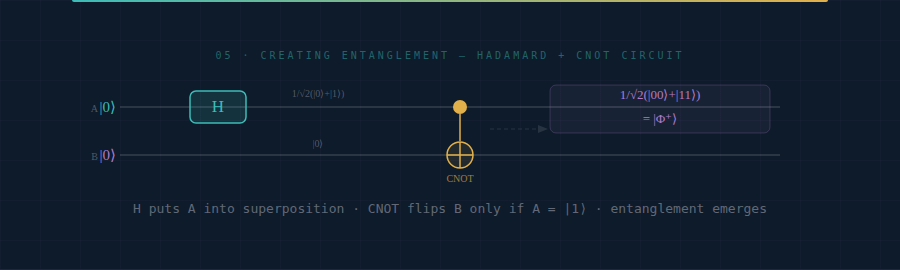
Hadamard plus CNOT circuit creating Bell state

This is the standard circuit for generating entanglement in quantum computers. Two gates. One entangled pair.

La mayoria de las explicaciones del entrelazamiento cuantico reducen uno de los conceptos mas precisos de la fisica a una vaga metafora. Esto es lo que realmente esta pasando.

La mayoria de las explicaciones del entrelazamiento cuantico son muy simplificadas y pueden estar bajo conceptos erroneos.

Reducen uno de los conceptos mas matematicamente precisos de la fisica a una vaga metafora de particulas "comunicandose" a traves del espacio. Ese enfoque no es solo impreciso. Oscurece activamente lo que hace poderoso al entrelazamiento, y por que importa para el futuro de la computacion.

Esto es lo que realmente esta pasando.

Que es Realmente el Entrelazamiento

El entrelazamiento no es una correlacion entre dos particulas. Es la imposibilidad estructural de describir dos qubits como dos sistemas independientes.

Para entender por que, comienza con el caso separable. Cuando dos qubits no estan entrelazados, su estado conjunto se factoriza limpiamente:

Separable state equation

Cada qubit tiene su propio estado bien definido. Puedes describir el qubit A completamente, con precision, sin ninguna referencia al qubit B. Son sistemas independientes que coexisten. Piensa en dos libros separados. Puedes leer uno sin abrir el otro.

El Estado de Bell: Una Historia, Dos Qubits

Ahora conoce el estado de Bell. Nombrado en honor al fisico John Bell, es el ejemplo mas simple e importante de un estado de dos qubits maximamente entrelazado:

Bell state equation

Para los no fisicos, esto es lo que esa notacion dice en lenguaje simple.

El sistema puede estar en dos resultados posibles: ambos qubits son 0, o ambos qubits son 1. El coeficiente 1/sqrt(2) significa que cada resultado tiene exactamente 50% de probabilidad. Hasta aqui suena como lanzar una moneda. Pero aqui es donde se pone extrano.

En un lanzamiento de moneda normal, la moneda es secretamente cara o cruz todo el tiempo. Simplemente no sabemos cual. En el estado de Bell, ningun qubit tiene un valor definido antes de la medicion. El resultado no existe todavia. Ambas posibilidades son reales y coexisten simultaneamente. Cuando mides, el sistema se resuelve en una de ellas instantaneamente, para ambos qubits al mismo tiempo, sin importar que tan separados esten.

Nota tambien lo que falta en esa ecuacion. No hay |01⟩ ni |10⟩. El sistema nunca se resolvera en A=0, B=1 o A=1, B=0. Los dos qubits estan perfectamente correlacionados de una manera que no puede explicarse por ningun acuerdo preexistente entre ellos. John Bell lo probo matematicamente en 1964, y los experimentos lo han confirmado desde entonces.

Matematicamente, la razon por la que este estado es tan especial es que no puede separarse. Intenta factorizarlo. Asume que existen α, β, γ, δ tales que el producto tensorial se mantiene:

|Φ⁺⟩ = (α|0⟩ + β|1⟩) ⊗ (γ|0⟩ + δ|1⟩)

Expande y compara coeficientes termino por termino. Obtienes:

Sistema de ecuaciones de factorizacion sin solucion

De αδ = 0, o α = 0 o δ = 0. Si α = 0, entonces αγ = 0, contradiciendo αγ = 1/√2. Si δ = 0, entonces βδ = 0, contradiciendo βδ = 1/√2. Ambos caminos llevan a contradiccion. No existe solucion.

Esto no es una afirmacion fisica. Es un hecho matematico sobre la estructura del espacio de Hilbert conjunto Hₐ ⊗ Hᵇ.

Volviendo a la analogia del libro: esto no son dos libros que cuentan la misma historia. Esta es una historia que no puede existir en dos libros separados. El momento en que abres cualquiera de los dos, la historia completa se resuelve, para ambos, simultaneamente.

El estado de Bell representa una historia que no puede separarse en dos libros independientes

El Teorema de No-Comunicacion

Si medir A determina instantaneamente B, significa eso que la informacion viajo mas rapido que la luz?

No. Y la prueba es elegante.

Si solo tienes acceso al qubit B, tu estado local es la matriz de densidad reducida, obtenida al trazar sobre A:

Matriz de densidad reducida mostrando estado maximamente mezclado

El resultado es el estado maximamente mezclado. Aleatoriedad pura. Sin importar lo que Alice haga al qubit A, ya sea que lo mida, aplique cualquier operacion, o lo deje intacto, las estadisticas locales de Bob permanecen completamente sin cambios.

En terminos simples: Bob ve 0 y 1 con igual probabilidad sin importar que. No tiene forma de saber si Alice midio su qubit o no. La correlacion solo aparece cuando ambos comparan resultados a traves de un canal de comunicacion clasico regular.

Lo que viaja instantaneamente es la correlacion. No la informacion.

Este es el teorema de no-comunicacion, y es exacto.

El teorema de no-comunicacion: la correlacion viaja instantaneamente, pero la informacion no

Por Que Esto Conecta con el Futuro de la Computacion

Escribi recientemente sobre como la computacion clasica se esta acercando a un techo fisico. Los transistores se han reducido por debajo de 10 nm, donde el tunel cuantico comienza a trabajar en nuestra contra en lugar de a nuestro favor. La Ley de Moore no esta muerta, pero se esta quedando sin espacio.

La computacion cuantica no intenta empujar los transistores mas alla. Abandona el paradigma por completo y se construye sobre los mismos fenomenos de mecanica cuantica que hacen la miniaturizacion tan dificil, convirtiendolos en un recurso computacional.

El entrelazamiento es ese recurso. No es una curiosidad. Es lo que hace que ciertas computaciones cuanticas sean estructuralmente imposibles de replicar en hardware clasico:

  • Teletransportacion cuantica: un estado cuantico desconocido se reconstruye en una ubicacion distante usando entrelazamiento mas exactamente 2 bits clasicos. No se requiere canal cuantico durante la transmision. Demostrado teoricamente en 1993 y verificado experimentalmente multiples veces desde entonces.
  • Distribucion de claves cuanticas: seguridad criptografica garantizada por la fisica, no por la dificultad computacional. Cualquier intento de espionaje introduce perturbaciones detectables al estado cuantico. El protocolo BB84, propuesto en 1984, sigue siendo la base de este campo.
  • Correccion de errores cuanticos: los qubits ancilla entrelazados permiten que un sistema detecte y corrija errores sin medir directamente los datos que se estan computando. Este es el mecanismo detras del chip Willow de Google logrando reduccion exponencial de errores a medida que aumenta el conteo de qubits.
  • Ventaja cuantica: los estados entrelazados permiten que los algoritmos exploren espacios de Hilbert exponencialmente grandes de maneras que ningun sistema clasico puede replicar. Esto no es cuestion de velocidad. Es cuestion de estructura.

El poder del entrelazamiento no es que desafie la relatividad.

El poder es que desafia la intuicion clasica sobre lo que un sistema siquiera es.

Por Que Persisten los Conceptos Erroneos

Einstein mismo llamo al entrelazamiento "accion fantasmal a distancia" y paso anos argumentando que probaba que la mecanica cuantica estaba incompleta. La paradoja EPR que coescribio en 1935 fue uno de los intentos mas serios de mostrar que la teoria necesitaba variables ocultas para ser coherente.

El teorema de Bell en 1964 cerro ese argumento matematicamente. Decadas de experimentos lo confirmaron. El entrelazamiento no es una senal de que la teoria esta rota. Es una senal de que la realidad es genuinamente mas extrana de lo que nuestras intuiciones clasicas permiten.

El entrelazamiento no nos da magia. Nos da una nueva estructura matematica para almacenar y procesar informacion, una que no tiene equivalente clasico.

Eso es lo que estamos aprendiendo a disenar.

Como Se Crea Realmente el Entrelazamiento?

La pregunta natural es: si el entrelazamiento es tan poderoso, como lo producimos? La respuesta es sorprendentemente simple. Una compuerta Hadamard pone al qubit A en superposicion. Una compuerta CNOT luego correlaciona al qubit B con A. El resultado es el estado de Bell:

Circuito Hadamard mas CNOT creando estado de Bell

Este es el circuito estandar para generar entrelazamiento en computadoras cuanticas. Dos compuertas. Un par entrelazado.

Karen Tovar Parra
Karen Tovar Parra

AI Engineering Lead at Datasite · Quantum ML Researcher · International Speaker.